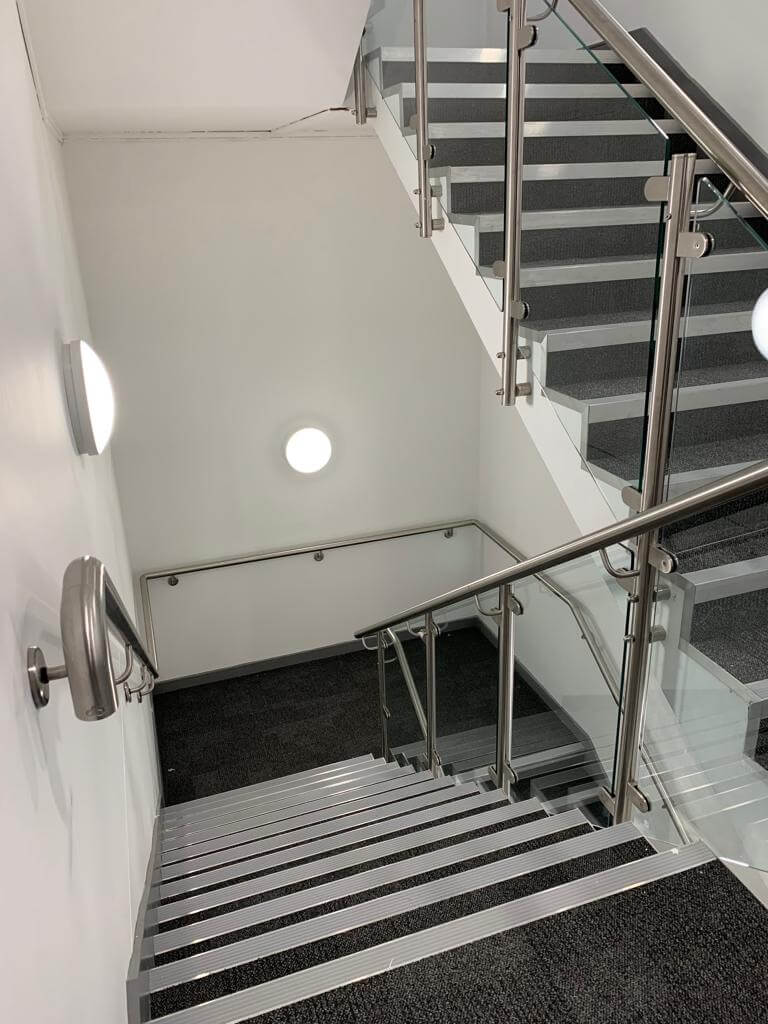
Choosing the right stair nosings for public buildings isn’t just about finishing a step edge neatly. In schools, care homes and commercial buildings, staircases often see high footfall, frequent cleaning, wet shoes, trolleys – and a wide mix of users with different mobility and visual needs.
The right commercial stair nosing helps to:
- reduce slips and trips
- improve step edge definition and visibility
- protect stair edges from long-term wear and damage
- support compliance and reduce liability in public access areas
This guide walks through how to specify the best option for each environment.
1) Start with the building type (and who uses the stairs)
Schools
- High footfall at peak times (start/end of day, break, class changeovers)
- Higher chance of impact damage (bags, PE kit, trolleys)
- Wet footwear and debris tracking in
- Often needs robust, easy-to-maintain solutions with clear step edge definition
Care homes & supported living
- Higher fall-risk users and slower movement
- Regular use of mobility aids and staff equipment
- Strong need for visual contrast and dependable anti-slip performance
- In some settings, low-light visibility can matter (early morning/evening movement)
Commercial buildings
- Requirements vary: premium front-of-house aesthetics vs. back-of-house durability
- Cleaning regimes can be intensive (mopping, chemicals, scrubber dryers)
- Compliance and risk reduction are often primary drivers
2) Confirm compliance and accessibility requirements early
In many public-facing settings, your choice of stair nosing is linked to accessibility and stair safety guidance. If you’re specifying for public access stairs, you’ll typically be thinking about:
- step edge definition (helping users identify the leading edge)
- contrast between the nosing/insert and the surrounding floor finish
- slip resistance appropriate to the environment (dry, wet, internal, external)
Helpful references on our site:
3) Choose slip resistance based on real conditions (not assumptions)
Slip resistance should match what the staircase will actually face day-to-day:
- Dry internal stairs: many ribbed or insert-based profiles are suitable
- Wet/contamination risk (entrances, food areas, frequent mopping): consider higher-grip inserts and more aggressive tread designs
- External steps: use profiles designed for weather exposure, temperature changes and water run-off
Explore:
4) Prioritise visibility: contrast, edge definition and consistent design
For schools and especially care homes, it’s not enough that a nosing “has grip” – users also need to see the step edge clearly and consistently.
Good practice usually includes:
- a profile with a contrasting insert (to improve edge definition)
- the same approach across flights and landings (avoid changing colours mid-staircase)
- avoiding overly patterned finishes at the leading edge that make the step hard to read
If you’re working to an accessibility-led specification, start with DDA compliant stair nosings and select a contrast that works with the surrounding floor finish.
5) Match the nosing type to the floor finish and stair construction
Choosing a great product is only half the job – the profile shape needs to suit the stairs and the finished floor covering.
Common scenarios
- Vinyl/LVT/linoleum: profiles designed to work with resilient flooring (often with a neat interface to the finish)
- Carpet: consider profiles that allow a clean carpet edge and secure fixing
- Tile: tile-in profiles can give a tidy, integrated finish (commonly used on new builds/refurbs)
- Concrete (new or existing): check the substrate condition and choose a fixing method that won’t fail in dusty or crumbling edges
- Timber: ensure you have adequate fixing depth and the correct screw type; also consider movement/seasonal expansion
If you’re unsure where to start, browse the full Commercial Stair Nosing range and then narrow down by environment and floor type.
6) Decide on fixing method: screw-fix, adhesive, or both
For high-traffic sites like schools and busy commercial buildings, a secure installation is critical. The “best” fixing method depends on the substrate and whether you can drill into it.
- Screw-fixed: generally very secure and often preferred for heavy-use areas (provided the substrate is sound)
- Adhesive-fixed: useful where drilling isn’t suitable, but depends heavily on surface preparation and adhesive choice
- Belt and braces: in some installations, combining methods (where appropriate) can reduce the risk of edges lifting over time
Tip: Always plan installation around cleaning routines. A poorly installed nosing edge can become a dirt trap – or worse, a trip hazard.
7) Consider durability: traffic, impact and maintenance
In schools and many commercial environments, durability is as important as slip resistance. Look for:
- robust, wear-resistant materials appropriate to the location
- inserts that can cope with abrasion and frequent cleaning
- a profile that protects the stair edge from chipping/spalling
Also consider cleaning chemicals and routines (especially in care homes), and choose finishes that won’t become slippery when polished or repeatedly mopped.
8) Use a simple spec checklist
Use this checklist to reduce back-and-forth during specification:
- Location: internal / external
- Building type: school / care home / commercial
- User needs: higher fall risk? visual impairment considerations?
- Slip risk: dry / wet / contaminated
- Floor finish: vinyl/LVT, carpet, tile, timber, concrete
- Fixing: screw / adhesive / other constraints
- Contrast requirement: yes/no; choose insert colour accordingly
- Maintenance: cleaning method, chemical exposure, frequency
9) Quick recommendations by building type
Best approach for schools
- Prioritise durability and anti-slip performance for peak footfall
- Use consistent high-visibility edge definition
- Choose fixings that can withstand daily wear and cleaning
Best approach for care homes
- Prioritise contrast and clear step edge definition
- Choose reliable anti-slip solutions that remain effective with regular cleaning
- Consider whole-building consistency to reduce confusion and mis-steps
Best approach for commercial buildings
- Balance front-of-house aesthetics with compliance and long-term wear
- Use more robust profiles for back-of-house, service stairs and entrances
- For external steps, use purpose-designed external stair nosings
Need help choosing the right stair nosing?
If you tell us the building type, whether the stairs are internal or external, and the floor finish (e.g., vinyl, carpet, tile), we can help point you to suitable options from our commercial stair nosing range.
For product advice, contact our sales team on 01558 507007.